
Dark Pool Trading Explained: How Large Institutions Move Markets Without Moving Prices
A clear, regulator‑aligned explanation of how institutional investors use Dark Pools to manage large orders without disrupting prices.
Dark Pools are an important part of the modern stock market, but the term is frequently misunderstood. Some traders assume Dark Pools are unregulated markets where institutions secretly manipulate stock prices. Others believe Dark Pool orders never appear in market data and cannot be studied on a stock chart.
Neither interpretation is accurate.
Dark pools are regulated off-exchange trading venues designed to help institutions execute large orders without displaying those orders to the public before the trades occur. Our focus at TechniTrader is on the largest Buy-Side Institutions who use these venues when they need to accumulate or rotate enormous numbers of shares without revealing their intentions or causing price to move sharply against them. *As the retirement account fund managers for the Fortune 500 companies, the giant buy-side institutions manage most of the 401(k)s and IRAs of working Americans.
At TechniTrader, we study how that institutional activity affects price and volume patterns via candlestick patterns and indicators on end-of-day stock charts. Understanding those relationships can help swing and position traders recognize when institutional support may be developing before High-Frequency Trading systems accelerate price improvement.
Technically, a dark pool is an Alternative Trading System, or ATS, that does not display its pre-trade order book to the public.
Unlike a traditional exchange, a dark pool does not publicly broadcast the presence, price, and size of its pending buy and sell orders. This allows institutions to place large orders with less risk of other market participants reacting before the transactions are completed.
Dark pools are not unregulated. They are subject to Securities and Exchange Commission regulations and FINRA oversight. Trades in listed stocks conducted through an ATS must be submitted to a FINRA Trade Reporting Facility and published on the consolidated tape. FINRA also releases delayed stock-by-stock trading statistics for individual Alternative Trading Systems.
FINRA explains that these venues were designed primarily to accommodate institutions trading large blocks of shares while reducing market disruption. You can read FINRA’s regulatory overview at Can You Swim in a Dark Pool?.
Myth |
Fact |
|---|---|
| Dark pools are unregulated secret markets. | Dark pools are regulated Alternative Trading Systems subject to SEC rules, FINRA oversight, trade-reporting requirements, and operational disclosures. |
| Dark Pool trades never appear in stock market data. |
Pending orders are not publicly displayed, but completed listed-stock trades must be reported and contribute to the daily consolidated price and volume data. |
| A dark pool is an institutional investor. |
Technically, the dark pool is the trading venue. TechniTrader often uses “Dark Pools” as shorthand for the giant Buy-Side Institutions whose activity on these venues we study. |
| Every off-exchange transaction represents giant institutional accumulation. |
Off-exchange activity also includes other types of execution, including Sell-side Institutions, Derivative Developers, Global Asset Managers, and even retail orders routed to wholesalers. The participant, order type, chart pattern, and surrounding market conditions must be considered together. |
| One Dark Pool print tells a trader what to buy. |
A trade print does not reveal the institution’s complete intention. TechniTrader studies developing relationships among price and volume patterns via candlesticks, indicators, trend, and market condition analysis. |
| Institutional buying guarantees that a stock will rise. |
Institutional investors have extensive resources and influence, but they are not infallible. Institutional activity must be evaluated as part of a complete risk analysis. |
The largest Buy-Side Institutions include mutual funds, pension funds, insurance companies, endowments, and other professional money managers responsible for investing pooled capital on behalf of millions of people.
When one of these institutions decides to build or reduce a major position, it cannot normally buy or sell all the necessary shares in a single public-market order. Revealing an enormous order on an exchange could cause other traders and algorithms to react, moving the price before the institution completes its transactions.
A dark venue allows the institution to work that order without publishing its pending bid or offer to the public exchange order book.
FINRA explains that institutional investors conduct large and frequent trades and account for a significant portion of stock market volume. Because of that dominance, their buying and selling can produce substantial moves in individual stocks and the broader market. These institutions also have extensive research resources and specialized investment teams, which is why institutional capital is sometimes called the “smart money.”
However, “smart money” does not mean infallible money. Institutions can make poor decisions, miss important changes, or reduce a position when the original reason for owning it changes. TechniTrader does not teach traders to copy institutional holdings blindly. We study whether price, volume, and other indicators suggest that influential institutions may be accumulating, holding, rotating, or reducing inventory.
In securities regulation, a dark pool is the venue. In TechniTrader education, I also use “Dark Pools” as a practical shorthand for the largest and most influential Buy-Side Institutions that execute substantial orders through these venues.
This is intentional.
Not every institution has the same purpose, capital base, holding period, or influence. The giant mutual funds, pension funds, and similar Buy-Side Institutions are especially important to swing and position traders because they:
When I refer to “Dark Pool accumulation,” I am not saying that a venue itself decided to buy a stock. I am referring to the controlled accumulation of shares by these giant Buy-Side Institutions through non-displayed institutional venues.
This usage connects the regulated market structure to what traders can study on a stock chart: the effect that large, carefully managed institutional orders have on price and volume through the study of candlestick and indicators patterns over time.
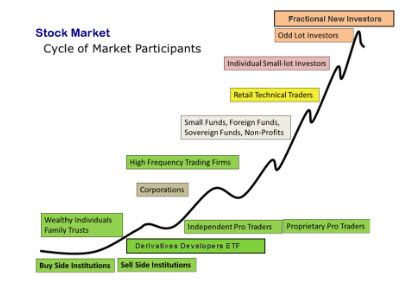
The Cycle of Market Participants explains why different groups tend to become active at different stages of a stock’s trend. I have updated the Cycle of Market Participants as new market participants emerge, such as the meme stock trading groups and fractional investors that came about in recent years due to new technological advancements. The following is a sample of the complete list of today's market participant groups, taught exclusively through TechniTrader's Methodology Essentials course.
The giant Buy-Side Institutions are the most important group at the beginning of the cycle because they buy first at the bottom. In TechniTrader’s model, their quiet accumulation establishes the institutional support from which an uptrend can develop.
Dark Pool Institutions are long-term investors. They study the company, its industry, the business cycle, emerging technologies, financial condition, and future growth prospects before committing large amounts of capital.
When they determine that a stock is undervalued or positioned for future growth, they begin accumulating shares while the stock is still bottoming. Their goal is not to create a sudden price run. A rapid rise would make the remaining shares more expensive and interfere with their ability to build the position.
Instead, they acquire shares gradually with controlled professional orders. Time Weighted Average Price orders, commonly known as TWAP orders, are one method institutions may use to divide a large order into smaller transactions over a defined period.
This quiet buying can continue while price appears to be moving sideways. Retail traders may see an uninteresting trading range. Relational Technical Analysis™ can reveal that the relationships between price and volume are changing beneath the surface.
This stage is what TechniTrader calls Dark Pool Quiet Accumulation™.
After institutional accumulation improves the underlying chart structure, professional short-term traders begin to recognize the developing opportunity.
Their activity creates the professional “nudge” patterns and candlestick signals TechniTrader uses for early swing and position trade entries. These signals can develop as the stock begins moving out of its bottom or consolidation, while the angle of ascent remains controlled and the risk relative to nearby support is still measurable.
This is the stage we watch for an actionable entry.
The objective is not to enter merely because we believe a large institution may be accumulating. We wait for the professional short-term traders to create the confirming buy signal.
High-Frequency Trading systems enter later in the cycle. They react to short-term triggers, changing liquidity, order-flow conditions, and strengthening price action.
HFT activity often creates the gaps, momentum runs, and sudden price acceleration that make a stock appear to have moved without warning.
The HFT gap is not the accumulation. The gap is the acceleration that occurs after institutional support and professional buying have already improved the chart.
By the time retail traders notice the dramatic price move, the lower-risk entry may have passed. This is why TechniTrader studies Dark Pool accumulation and Professional Trader patterns: the goal is to identify a qualified entry before HFTs accelerate price, not to chase the stock afterward.
As price rises and the uptrend becomes increasingly visible, smaller funds and retail traders begin entering. Their buying can extend the trend, but it also changes the risk profile, which is one of the most important aspects of the analysis before any trade is placed.
A stock that was quietly accumulated near the bottom eventually develops a steep angle of ascent, excessive speculation, or a widening distance from support. Understanding where a stock is in the Cycle of Market Participants helps traders distinguish an early developing opportunity from a move that is already crowded or overextended.
 Intellectual property of Martha Stokes, CMT of Decisions Unlimited, Inc. DBA TechniTrader®
Want a quick reference while reviewing your charts? Download the free Dark Pool Chart-Clue Quick Check to help you spot potential signs of institutional activity:
https://www.technitrader.com/products/digital_downloads/dark-pool-chart-clue-quick-check
Dark Pool orders are not displayed on a retail trader’s Level 2 screen before execution. That does not mean completed transactions vanish from the market’s data.
FINRA states that listed-stock transactions occurring through Alternative Trading Systems must be reported to a Trade Reporting Facility and published on the consolidated tape. The executed trades therefore contribute to the price and volume data used in end-of-day stock charts.
A chart does not label an individual candle “Dark Pool buying,” and one transaction cannot reveal an institution’s complete strategy. What traders can study is the relational patterns created as large orders are executed gradually over time.
TechniTrader looks for combinations of:
No single candle or indicator is treated as proof. The analysis comes from the relationship among multiple chart elements and the stock’s position within the broader trend, with consideration of the market-participant cycle.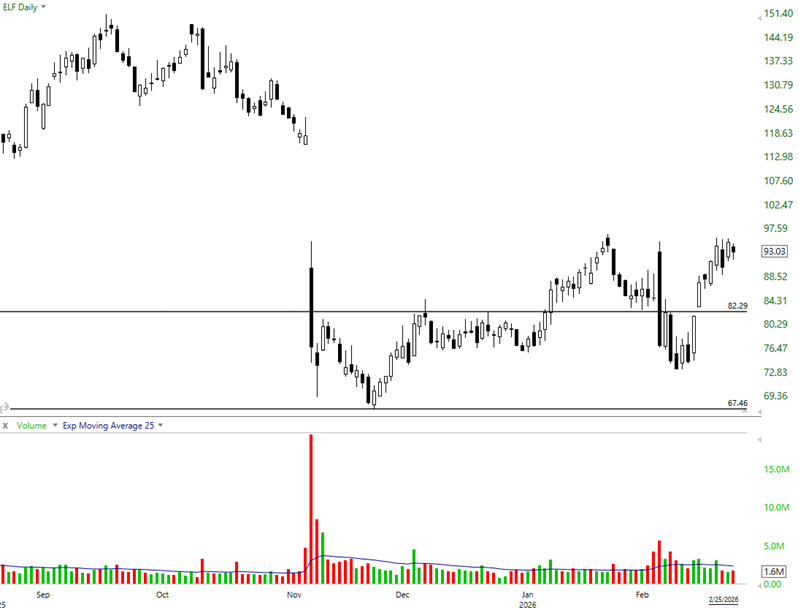 Example of a stock forming a quiet institutional accumulation pattern on a daily chart. Chart created by TechniTrader® using TC2000® charting software.
Institutional activity does not always mean that an institution is establishing a completely new position.
A giant Buy-Side Institution may be:
TechniTrader uses Dark Pool Quiet Accumulation™ patterns to identify controlled institutional buying and Dark Pool Quiet Rotation™ patterns to give early warnings when the chart suggests that institutions may be adjusting inventory.
These patterns matter because institutional support can influence the quality and duration of a trend. A stock with continuing Buy-Side support behaves differently from one in which institutions are quietly lowering inventory.
The phrase “dark market” is also used broadly when discussing retail orders routed away from public exchanges.
Many commission-free brokers route retail orders to wholesalers through payment-for-order-flow arrangements. In that situation, a wholesaler pays for the opportunity to execute the broker’s retail order flow. The SEC has discussed how this practice can reduce direct order-by-order competition among public exchanges and can create potential conflicts of interest. You can review the SEC’s explanation of dark markets and payment for order flow.
This is not the institutional activity TechniTrader means when discussing Dark Pool accumulation.
TechniTrader uses the term “Dark Pools” to focus specifically on the giant Buy-Side Institutions whose large-lot, long-term accumulation and rotation can affect daily chart patterns and the development of sustained trends. Retail wholesaling and short-term HFT activity serve different purposes and produce different market behavior.
Most retail traders are taught to study a stock only after price begins moving. That often causes them to notice the trade during the HFT acceleration phase, when the stock is already gapping or running, and the distance from support is expanding.
Understanding the Cycle of Market Participants changes what the trader watches.
Instead of asking only whether price is rising, the trader can evaluate:
The objective is not to predict every institutional decision. It is to understand who may be controlling price, where the stock is in its participant cycle, and whether the chart offers an entry appropriate for the trader’s style and risk tolerance.
Dark Pool analysis is not based on a list of mysterious trade prints or a single “secret” indicator. It requires an understanding of modern market structure, candlestick patterns, price and volume relationships, and the sequence in which the market participant groups become active.
In the complimentary Dark Pool Candlestick Signals mini-course, I introduce:
Start the Free Dark Pool Candlestick Signals Course
No credit card is required.
Recognizing possible Dark Pool activity is one component of stock analysis. A complete trading process must also evaluate the market condition, the stock’s trend and position within that trend, support and resistance, indicators, candlestick signals, risk versus potential return, position size, and trade management.
The Methodology Essentials Training Program brings those components together into TechniTrader’s structured process for selecting, planning, practicing, and managing swing and position trades (as well as longer-term investments).
Explore the Complete Methodology Essentials Program
Trade Wisely,
Martha Stokes, CMT
Co-Founder, CEO and Head Instructor, TechniTrader®
Retired Buy-Side Technical Analyst
Developer of the Cycle of Market Participants™ and Relational Technical Analysis™